Nothing says “motorcycle” like a naked air-cooled sporty bike. They are little more than an engine with a couple of wheels tacked on at either end. No unsightly radiators and their attendant plumbing, and no plastic fairings hiding the mechanical bits – they’re the epitome of elemental motorcycling.
But in this slice of moto-dom, there are a few different philosophies. Ducati’s Monster 1100 represents an Italian school of thought, with eye-catching styling that befits its country of origin. One of the originators of the naked sportbike movement, this new Monster’s abbreviated trellis frame pares down the bike’s visible components to a level that an untrained eye might wonder how the thing is held together.
The North American viewpoint is provided by Harley-Davidson’s new XR1200, an homage to the most American form of two-wheel motorsport, dirt-track racing. Other than its modern aluminum swingarm and triple-disc brakes, the XR appears as if it could’ve rolled off the pages of a Cycle News race report from the 1960s.

What we have here are two machines that are literally half a world apart in origin, and probably a galaxy apart in styling philosophy. Yet the commonality of simplicity – the simplicity of a no-nonsense air-cooled Twin as a power source – make the Harley-Davidson XR1200 and Ducati Monster 1100 brothers in arms.
Engine
The engines are the centerpieces of stripped-down naked bikes, dictating to a large extent both the bike’s style and the layouts of their chassis. Beautifully on display in both of these streetfighters are versions of the most iconic V-Twins ever produced.
The XR1200’s engine has roots that stretch back several decades, using old-tech elements like pushrod valve actuation for its two valves per cylinder. Ducati’s desmodue (two valves per cylinder) powerplant has its origins in the Pantah first seen all the way back in 1979, but it uses higher-tech bits than the Harley like belt-driven overhead camshafts and desmodromic positive valve closure. Both bikes have modern fuel-injection systems that deliver excellent throttle response and emissions compliance.

It’s heavy but it’s pretty. Pretty heavy!
As such, the H-D has a sweet zone on its tach that you'll need to be in most of the time if you want to stay butt-sniffing close to the Duc. And unless you've a racer's heart that allows you to charge corners hard and carry speed out the other side, you can expect a little bit of tap dancing on the shifter to stay in that sweet spot.
Engines, especially this character-laden pair, are about more than the raw data they produce. For example, the Duc's lighter flywheel means the engine can spin up quicker which can also, at times, mean a more immediate smack of low-end torque. This makes delicate, minor throttle input a tad challenging at times, say, when making mid-corner line changes.
Conversely, the 'Muhrican's big ol' honkin' engine masses spin a little slower than the Duc's. The XR's bigger flywheel effect and good fueling equate to a deliberate yet friendly build-up of power. Steady as she goes. But that same flywheel effect also impacts shifting in the five-speed transmission. The big motor keeps a spinnin' after you've pulled in the clutch, which means smooth and quick shifts aren’t as easy as with the Monster’s six-speed gearbox.
The other major distinction in the engine department stems from the arrangement of the twin cylinders. All modern Ducatis have their cylinders placed in an L shape 90 degrees apart. This architecture delivers perfect primary balance, which means that vibration is relatively smooth, allowing it to spin up higher.

In contrast, the Harley’s Sportster-derived motor has its cylinders arranged in The Motor Company’s traditional 45-degree Vee, which necessarily creates stronger vibes. This is most noticeable at idle where the XR shudders and shakes with such amplitude that it can almost blur a rider’s vision while waiting for the stoplight to turn green. Rubber engine mounts introduced on Sportsters in 2004 do an excellent job at subduing unpleasant vibes at all cruising speeds.
Handling
Though the XR1200 rides on the same basic Sportster high-strength steel cradle frame as other Sporties, it does come with a brand-spankin’-new hollow cast-aluminum swingarm that Harley says is upwards of 40% stiffer than the typical box-section steel Sportster swingarm. Keeping the front wheel stuck to the ground is a non-adjustable USD 43mm fork.
Rear suspension is another area the XR stands out, but not so much in a good way. The twin coil-overs certainly do look the part of the past the XR draws its inspiration from, but they allow a little too much wiggle and wallow. And, as Kevin says, “the excessive high-speed compression damping from the twin shocks can jump-start a heart-attack victim while riding over big expansion joints.”
However, with sticky Dunlop Qualifiers (18-inch front, 17-inch rear) developed specifically for the XR, aggressive cornering is cake… after you’ve ground down, literally, some more clearance between the bike and road. The right-side footpeg feelers touch relatively early, and the heat shields for the twin upswept exhaust follows soon after.

The Monster one-ups the Hog a bit by utilizing the same large-tube steel trellis frame as its smaller brother, the 696, a frame that is made from the same tube stock as the 1098R. A stout cast-aluminum subframe bridges the trellis to a sexy but strong single-sided swingarm via a link-less shock. The bottom line: this is one stiff chassis.
The fully adjustable 43mm USD Showa fork soaks up the rough stuff quite well. A Sachs shock performs admirably, too, but telegraphs some harshness, though only on large, sharp-edged bumps. A pair of Bridgestone’s BT016 tires adhere the Monster to the tarmac perfectly.
Differences in the bikes handling qualities mirror the general differences between each bike’s overall characters. Hindering the Harley’s performance is its porky weight. H-D says it scales in dry at 562 pounds. The Monster is claimed to be 189 pounds lighter!
This serious weight disadvantage, nearly 3-inch longer wheelbase and a rake angle 5 degrees softer than the Duc’s means it won’t handle nearly as lively. But with wide, upright handlebars, manhandling the Harley like, well, like a dirt-track rider might, is easy work. Shoving and pulling aggressively on the XR’s bars, flipping back and forth between corners while sitting upright, helps mask a lot of its extra weight and mild geometry.

Contrary to the active ride on the XR, the Monster’s sporting nature equates to easy steering input and solid confidence. The Ducati can make you feel as though you’re on a magnetic rail, as it simply and without trouble follows the arc of the turn as though it knows exactly where you want to go. About our only chassis complaint is the 1100’s occasional propensity to shake its head vigorously if the front gets a little light, say from riding over an expansion gap on the freeway while hard on the gas. A steering damper would make a nice gift for the holidays.

Brakes
Pete sits comfortably after coming to an easy stop thanks to the radial-mount Brembos that squeeze those big pie plate 320mm rotors on the Monster.
The Milwaukee-based Motor Company came up a winner when it introduced optional ABS-equipped Brembo power on its touring models over the past couple years. Now with the XR, Harley sincerely seems to be catching up to the rest of the sportbike world in terms of brake performance.
There’s no question the XR’s Nissin-made binders crush down mercilessly on the 292mm rotors, but their strong initial bite will certainly catch a few people by surprise if they’re accustomed to a typical Harley stopping experience. The brakes provide heaps of power, yet not enough sensitivity to match; locking the front is all too easy. Better than not stopping well, we guess.
A pair of radial-mount 4-piston Brembo calipers and 320mm rotors similar to the 696 slow things down on the Monster 1100, but as Kevin noted from the Duc’s launch, “it adds a radial-pump master cylinder to send fluid through its braided-steel lines, which Ducati says offers the same stopping power with 17% less lever pressure.”
And that’s the key difference in braking: The Monster offers better feel than the Harley, though both stop with similar force. Adding the XR’s powerful rear brake to the equation considerably aids its ultimate stopping distance.
Instruments / Controls / Fit 'n Finish
In keeping with the simplistic theme of a dirt-tracker, the XR’s instrumentation has a basic analog tach and very visible LCD speedo, rounded out with the usual array of idiot lights. “The XR’s instruments offer a paltry amount of info compared to the Ducati’s comprehensive gauges,” Kev noted. Indeed the Duc’s one-piece LCD tach and speedo are but a small part of the offering on tap in this race-bike-like gauge package that’s nearly identical to the 1098.
The Duc’s DDA-ready (Ducati Data Analyzer) gauges employ a digital tach that’s easily read, and all info is toggled from one switch on the left switchgear. Unfortunately, it seems one thing hasn't changed for Ducati: the lack of an indicated redline. Clutch action is moderate if not light on the Duc, and all its levers and switches are slim and trim yet aren’t flimsy.


The Harley’s clutch and brake levers are big and wide; a comfortable grasp is the result. We really liked the rounded and well-integrated switchgear, but Kevin found a nit to pick in another area. “The rear brake master cylinder forces a rider’s right foot outboard several inches more than the left side.”
Because the Duc is an Italian, like most Italians it’s pretty well buttoned-up in terms of unsightlies being kept out of sight, a situation much improved over the previous generation of Monsters. The Harley, on the other hand, leaves a little bit to be desired in the Fit and Finish department. A couple of bolts here and there could use hiding or a simple cover of some type, and though it isn’t necessarily ugly, the oil cooler mounted on the left-side frame downtube is conspicuous. Makes us nervous, too, thinking what might happen to it in a minor crash.
Ergonomics / Comfort
The standard-style upright riding position of the XR means you’re not hunched over or leaned forward for too long. The reach from the saddle to the wide flat-track-inspired bars is easy, though the seat-to-peg relation may seem a little tight for those over, say, six feet tall. This riding position lends to muscling the bike around the canyons, as noted above, but also means commuting or casual riding is comfortable. Freeway windblast can be a bit of problem, as the bike really doesn’t offer any protection, but we’ve ridden worse.

Getting into corner-attack position is easier and more natural on the Ducati, not to say it’s uncomfortable. Seating position is still very much standard-style, but the bars are flatter and the pegs feel higher and more rear-set (which is also why the Duc as great ground clearance). Surprisingly, a 40-plus-mile freeway stint is remarkably easy despite a dearth of wind protection much like on the XR.
Finally, though the Duc has a higher ride height via increased stroke in the fork for more ground clearance than the Monster 696, putting both feet flat at a stop is a cinch on the big Monster. Anyone with an inseam of 28 inches should feel at ease. The touring capabilities of the 1100 and XR are limited by diminutive fuel tanks, 3.8 and 3.5 gallons, respectively.
Appearance / Cool Factor
As far as we’re concerned there’s no denying the XR1200’s cool factor. It’s the first production Harley to successfully mimic the dirt-track dominating XR750! Sure, we’ve heard a few whiners out there say the tailsection is too big and needs to be trimmed, or that some type of side-mount carbs or throttle bodies would really make it look like a 750 racer. Bahhh! We say, especially in the orange color scheme, the XR1200 looks great and taps into the visceral draw of Harley’s unmatched flat-track racing heritage.
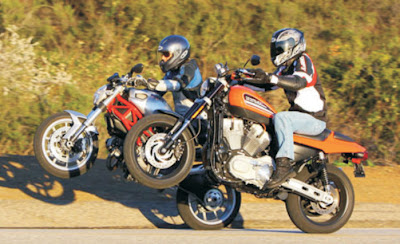
The Monster is unquestionably an attention-getter. The boldness of the trellis frame is countered by the sexy single-sided swingarm exposing the sinewy rear wheel and the round, soft lines of the faux-fuel tank blend-in well with the sweeping seat. Yep, it’s a lust-inducing Italian creation. And it has the performance package to go with its svelte streetfighter good looks.
Conclusion
Americans and Italians speak different languages, and this carries over to the design languages of motorcycle manufacturers. Ducati’s rich sporting heritage is evident in the Monster 1100’s more exuberant personality. Its lighter weight, shorter wheelbase and revvier motor give it an edge in strict performance terms.
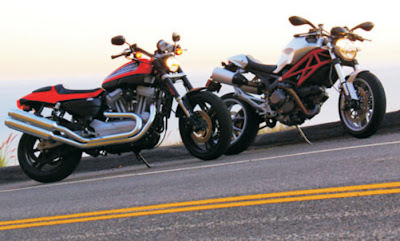
In any light, the Harley-Davidson XR1200 and Ducati Monster 1100 can look like the best bikes in the world for those who love these kinds of machines.
On the other hand, Harley’s XR1200 brings a fresh take on the naked roadster. Its success lies in the fact that it attracts sport riders and Harley faithful in equal measures. Its dirt-track inspiration resonates with a huge cross-section of two-wheel enthusiasts, and this broadband appeal and friendly nature places the XR in an enviable position during normal city / commuter use. It’s also about $1200 less than the swanky Italian.
Still, although it’s the highest-performance H-D ever offered for mass consumption (sorry, the ill-fated and semi-street-legal VR1000 doesn’t count), the XR1200’s rangier wheelbase and extra poundage means that – given equal riders – the XR can’t hang with the more agile and lively Monster down a twisty mountain road.


